Safety nets for buildings explained
Common areas in a housing society are used by dozens of families, which raises the stakes for a single unprotected opening.
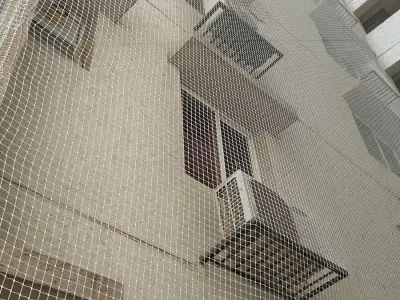
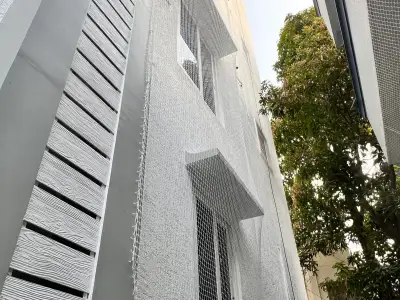
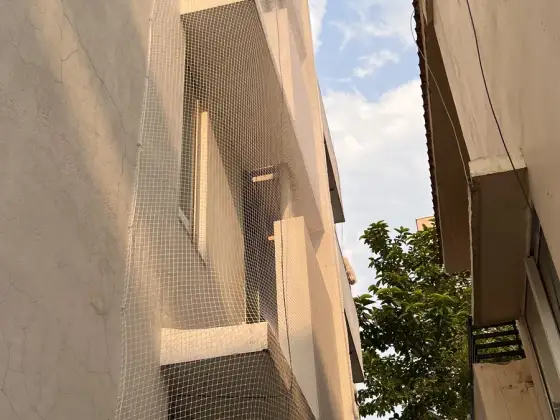
For whole-building work we plan net panels floor by floor, working from a rope-access harness or platform. We walk the building with the management committee, marking every opening, shaft and corridor that needs coverage.
Mysuru homes and safety nets for buildings
Open terraces, external staircases and first-floor balconies are the main fall risks in Mysuru's independent houses. Safety nets handle these irregular openings well. For apartments, and for front-facing balconies where looks matter, invisible grills give protection without changing the appearance of the building much.
Mysuru is about 770 metres above sea level and has a mild climate for most of the year, with warm summers and moderate rain in both monsoon seasons. Conditions are gentle on materials, but UV-stabilised net and stainless fixings are still what make an installation last. 304-grade stainless steel is normally enough for invisible grills here.
Because so much of Mysuru is independent housing, a typical job here covers several small openings on one house instead of a single large balcony: a terrace edge, a staircase, a couple of windows and a utility area. Residents also care about appearance, so a neat finish that does not spoil the look of the house matters.
When Mysuru homes need safety nets for buildings
These are the problems we are called out for most often:
- Standard balcony railings leave gaps that a small child can slip through or climb over within seconds.
- A single unprotected open corridor is enough for a fall, and most incidents happen when a parent looks away briefly.
- Plain grills give a false sense of security when the bars are wide enough for a head or body to pass through.
Installing safety nets for buildings step by step
This is how a safety nets for buildings installation normally proceeds:
- Anchor points are drilled into sound concrete or masonry and fixed with chemical or expansion anchors as the wall requires.
- We measure every edge, then cut the net to the opening with a border rope sewn along the perimeter.
- The net is stretched taut between stainless-steel anchors so it does not sag when a child leans on it.
Materials and what to look for
We normally use UV-stabilised HDPE or nylon mesh, Braided border rope, Stainless-steel anchors and hooks and Weather-resistant binding cord. Before you choose any installer, ask about the following:
- Choose a colour that blends with the building, since a well-chosen white or transparent net is barely noticeable from inside.
- Ask about mesh size: a smaller mesh is essential wherever young children can reach the net.
- Check that the net is UV-stabilised, because untreated nylon becomes brittle within a couple of Mysuru summers.
Pricing safety nets for buildings: the main factors
We do not quote by phone without seeing the space, because prices depend on the job. The main factors are:
- Working at height, especially above the fifth floor, may need rope-access set-ups that add to the effort.
- Removing old nets or making good after them is charged separately if needed.
- The total area to be covered, measured in square feet, is the main driver of cost.
Our installation process
- Free site visit and measurement of the opening
- Recommendation on mesh size, colour and fixing method
- Installation by trained technicians, usually in a few hours
- Tension test, cleanup and handover with care tips
Care and maintenance
A little regular care keeps safety nets for buildings working for years:
- Check the border rope and corner anchors twice a year, especially before and after the monsoon.
- Never hang heavy items from the net; it is a safety barrier, not a support frame.
- Rinse the net with clean water every few months to remove dust.
Other safety nets options
If safety nets for buildings is not quite what you need, these related options may suit your space better:
Where we install safety nets for buildings in Mysuru
We take safety nets for buildings bookings across Mysuru, including Chamundipuram, Yadavagiri, Ramakrishnanagar, Nazarbad, Bogadi, Dattagalli, Hebbal and JP Nagar and the areas around them. Send us your location and we will confirm a free site-visit slot.
Further reading: Mysore (Wikipedia)