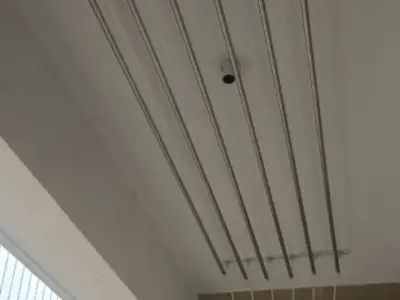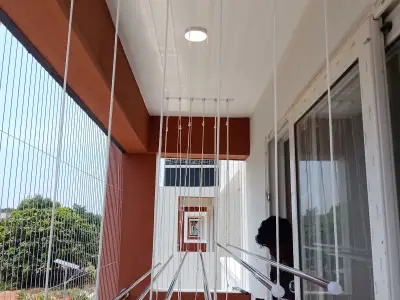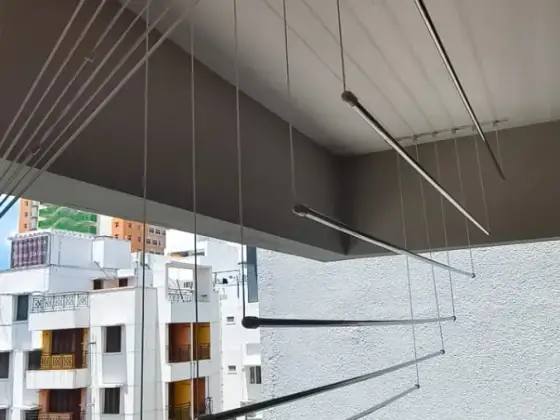
Ceiling cloth hangers explained
Ceiling cloth hangers lift laundry up near the slab, where warm air dries it quickly and floor space stays free.
Ceiling hangers are fixed with expansion anchors into concrete and tested for smooth pulley action. We check the ceiling material carefully, since false ceilings need fixing into the slab above.
What matters for ceiling cloth hangers in Pune
During Pune's monsoon, clothes can take days to dry outdoors. A ceiling cloth hanger in the dry balcony keeps laundry sheltered and in moving air, and lifts it clear of the floor space.
Pune's housing is organised around co-operative housing societies, from the older low-rise buildings of Kothrud, Aundh and Sahakar Nagar to the large gated townships of Hinjewadi, Wakad, Baner, Kharadi and Hadapsar. The IT parks at Hinjewadi, Kharadi and Magarpatta have driven a wave of high-rise construction, and neighbouring Pimpri-Chinchwad has grown just as quickly.
Most work in Pune has to fit in with society rules. Many societies ask for a particular net colour or grill pattern so the building looks uniform, and some arrange netting for an entire wing at once. In older Pune buildings we often work on open ducts, dry balconies and terraces that were never designed with bird-proofing or child safety in mind.
Why ceiling cloth hangers matters in Pune
Here is what usually leads Pune households to ask for ceiling cloth hangers:
- Floor-standing drying stands crowd a small balcony and cannot be stored easily in a compact flat.
- Poor anchoring can loosen under a heavy load of wet bedsheets or curtains.
- A low, sagging clothes line gets in the way of doors, fans and movement.
Our ceiling cloth hangers method
Every job follows the same careful sequence, adapted to the building:
- Rope or cable is set to the right length so the rack sits level at every height.
- We test with weights that represent real laundry before we hand over.
- Anchors are drilled and fixed to take the full weight of a wet load with a safety margin.
Materials and what to look for
We normally use Rust-resistant aluminium rods, Stainless-steel pulley and fittings, Nylon rope or cable and Expansion anchors and screws. Before you choose any installer, ask about the following:
- Ask for rust-resistant aluminium or stainless components, since steel parts corrode in humid weather.
- Confirm that the mechanism runs smoothly by pulling it up and down before you accept the job.
- Check the weight rating, and choose a bigger capacity if you dry bedsheets and curtains.
What affects the price of ceiling cloth hangers
We do not quote by phone without seeing the space, because prices depend on the job. The main factors are:
- Removal of an old hanger is quoted separately when required.
- Installing several hangers in one visit is usually more economical.
- The model, number of rods and load rating are the biggest cost factors.
Our installation process
- Free assessment of your balcony or utility area
- Recommendation of the right hanger and fixing
- Installation and smooth-run testing
- Weight test and demonstration
Looking after ceiling cloth hangers
A little regular care keeps ceiling cloth hangers working for years:
- Lubricate moving parts lightly with a suitable oil every few months.
- Check the ceiling anchors and rope once or twice a year and replace worn parts.
- Wipe the rods and pulley with a dry cloth every month to avoid rust and dust.
Other cloth hangers options
If ceiling cloth hangers is not quite what you need, these related options may suit your space better:
Where we install ceiling cloth hangers in Pune
We take ceiling cloth hangers bookings across Pune, including Katraj, Sinhagad Road, Pimple Saudagar, Aundh, Kothrud, Undri, Kondhwa and Viman Nagar and the areas around them. Send us your location and we will confirm a free site-visit slot.
Further reading: Pune (Wikipedia)