Safety nets for duct areas explained
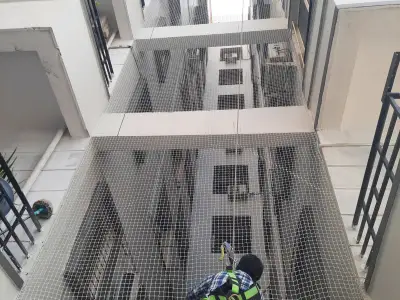
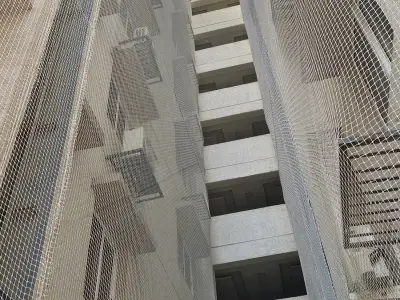
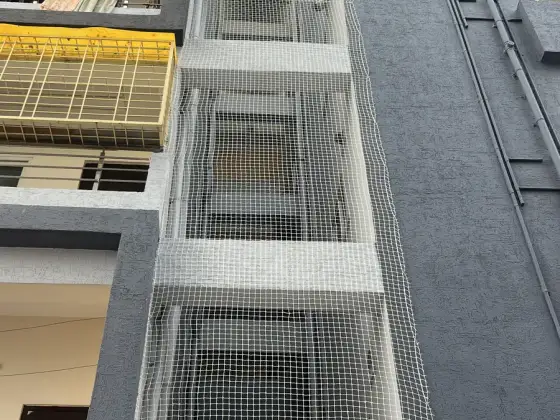
Service ducts carry pipes and cables between floors, and open ones are a fall and dropped-object risk as well as a bird roost.
For ducts we build removable panels or access flaps, so plumbers and electricians can still reach pipes and meters. We confirm that any maintenance access remains clear before we close off an opening.
Pune homes and safety nets for duct areas
In Pune's newer towers, families with young children commonly ask for invisible grills on balconies and safety nets on windows and dry balconies. Because most societies want a uniform look, invisible grills are popular: they are hardly visible from outside. On higher floors we plan anchors for wind, and we always confirm the wall type before drilling.
Most work in Pune has to fit in with society rules. Many societies ask for a particular net colour or grill pattern so the building looks uniform, and some arrange netting for an entire wing at once. In older Pune buildings we often work on open ducts, dry balconies and terraces that were never designed with bird-proofing or child safety in mind.
Pune's housing is organised around co-operative housing societies, from the older low-rise buildings of Kothrud, Aundh and Sahakar Nagar to the large gated townships of Hinjewadi, Wakad, Baner, Kharadi and Hadapsar. The IT parks at Hinjewadi, Kharadi and Magarpatta have driven a wave of high-rise construction, and neighbouring Pimpri-Chinchwad has grown just as quickly.
The case for safety nets for duct areas
These are the problems we are called out for most often:
- Open sections near the duct area let loose objects such as toys, pots and tools drop onto people below.
- Plain grills give a false sense of security when the bars are wide enough for a head or body to pass through.
- Elderly family members with balance problems benefit from a soft barrier that catches a stumble.
Installing safety nets for duct areas step by step
This is how a safety nets for duct areas installation normally proceeds:
- Where drilling is not allowed, we use clamp-on frames or tension rods that grip the existing structure.
- Once fitted, we press-test the net across its full area to confirm there is no slack at any point.
- We measure every edge, then cut the net to the opening with a border rope sewn along the perimeter.
Specifications worth asking about
We normally use UV-stabilised HDPE or nylon mesh, Braided border rope, Stainless-steel anchors and hooks and Weather-resistant binding cord. Before you choose any installer, ask about the following:
- Ask about mesh size: a smaller mesh is essential wherever young children can reach the net.
- Insist on stainless-steel or coated fittings; cheap zinc hooks rust quickly in damp monsoon air.
- Choose a colour that blends with the building, since a well-chosen white or transparent net is barely noticeable from inside.
How safety nets for duct areas is quoted
We do not quote by phone without seeing the space, because prices depend on the job. The main factors are:
- Working at height, especially above the fifth floor, may need rope-access set-ups that add to the effort.
- Removing old nets or making good after them is charged separately if needed.
- The number and type of anchor points needed depends on the wall material and the opening shape.
Our installation process
- Free site visit and measurement of the opening
- Recommendation on mesh size, colour and fixing method
- Installation by trained technicians, usually in a few hours
- Tension test, cleanup and handover with care tips
Looking after safety nets for duct areas
A little regular care keeps safety nets for duct areas working for years:
- Never hang heavy items from the net; it is a safety barrier, not a support frame.
- Check the border rope and corner anchors twice a year, especially before and after the monsoon.
- Rinse the net with clean water every few months to remove dust.
Other safety nets options
If safety nets for duct areas is not quite what you need, these related options may suit your space better:
Where we install safety nets for duct areas in Pune
We take safety nets for duct areas bookings across Pune, including Kothrud, Wagholi, Undri, Wakad, Hadapsar, Baner, Kharadi and Katraj and the areas around them. Send us your location and we will confirm a free site-visit slot.
Further reading: Pune (Wikipedia)