Why Sholinganallur properties need pigeon nets for duct areas
Many residents are working couples away all day, so a tidy installation completed in one visit matters. Nesting material, feathers and dead chicks block drains, vents and ducts near the duct area.
Bird mites and ticks from old nests can move into homes through open windows and balcony doors. IT-corridor high-rises have long exposed balconies at height, where wind pressure on nets and cables is substantial.
Local notes for Sholinganallur homes
Sholinganallur is the point where the OMR (Rajiv Gandhi Salai) meets the East Coast Road link, and it has become one of the densest clusters of high-rise housing in Chennai. Towers of fifteen floors and more stand next to the ELCOT IT Park and other tech campuses, and many residents are IT professionals and young families.
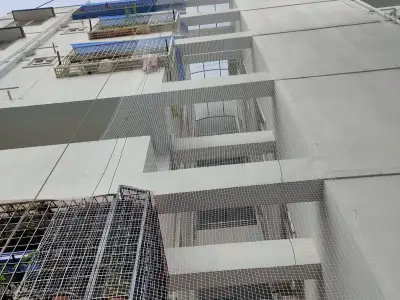
On the upper floors of Sholinganallur towers, pigeons nest behind AC units and in balcony corners, especially where balconies stay unused during the working day. Because wind at height is strong, we tension nets firmly and use more anchor points than on a low-rise building, so the net does not sag or flap over time.
Our pigeon nets for duct areas installation approach in Sholinganallur
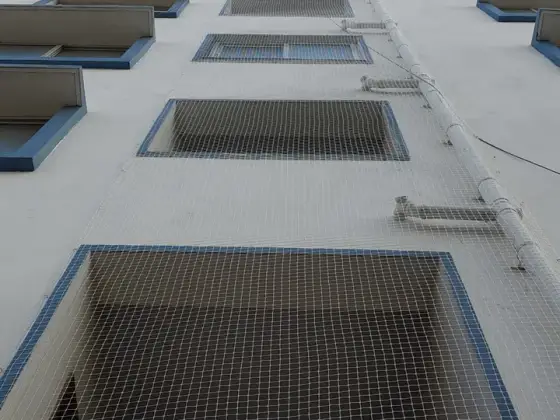
For duct areas we net across the openings while leaving pipes and cables free to be serviced. Net panels are fixed to the frame with stainless-steel hooks so there are no gaps a bird can squeeze through. We measure the opening and choose a mesh small enough to keep pigeons out but still let air and light through.
Whether it is high-rise gated apartments or independent houses in newer layouts, we walk the whole space first and note every gap a bird could use.
We inspect for existing nests and droppings, which should be cleared safely before netting.
Materials we use for pigeon nets for duct areas
Typical materials on a pigeon nets for duct areas installation are Knotless HDPE or nylon pigeon net, UV-stabilised binding cord, Stainless-steel hooks and clips and Corrosion-resistant fixing screws.
One more local factor: Wetlands and open plots along the corridor bring plenty of crows and kites to the towers.
What to ask any installer before you agree:
- Choose mesh of about 40 to 50 mm for pigeons, since a larger mesh lets small chicks slip in.
- Ask whether the net can be lifted or opened for cleaning windows and AC servicing.
- Look for UV-stabilised material, so the net does not turn brittle and snap in Chennai's summer sun.
Pricing pigeon nets for duct areas in Sholinganallur
We do not quote pigeon nets for duct areas prices without seeing the space, because every duct area in Sholinganallur is different. These are the factors that move the price:
There is no charge for the visit in Sholinganallur, and you decide only after seeing the written quote.
- Mesh grade and cord thickness affect both price and lifespan.
- Cleaning out old nests and droppings before installation is charged separately when needed.
- Height and access matter, since upper-floor work may need rope-access or a suspended platform.
How a pigeon nets for duct areas job works
We arrange the Sholinganallur visit around your schedule, then confirm scope, materials and timing in writing.
- Free site visit and measurement of the affected area
- Selection of the right mesh and fixing plan
- Installation sealing every gap birds could use
- Final inspection and a short care guide
Looking after your installation
Maintenance is light, but a few habits make a real difference in Sholinganallur:
- Keep plants and hanging items clear of the net so nothing tears or stretches it.
- Check for tears or loose hooks after storms and repair them promptly.
- Avoid feeding pigeons nearby, because a regular feeding point draws flocks back to the area.
Serving Sholinganallur and its neighbours
We cover Sholinganallur and the neighbouring areas of Navalur, Medavakkam, Thoraipakkam and Perungudi. Along the OMR and IT corridor, including Sholinganallur, Perungudi and Navalur, tall towers face strong winds and salty air, so strength and finish matter more than usual.
Further reading: Rock dove (Wikipedia)