What safety nets for duct areas involves
Duct openings are easy to overlook, yet they can drop anything, from a phone to a person, straight down several floors.
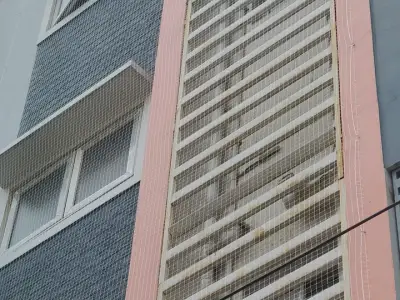
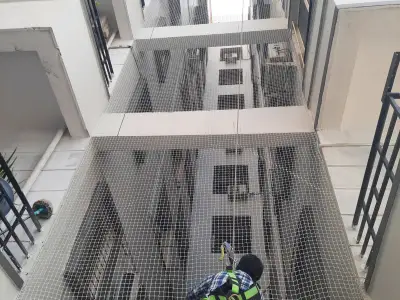
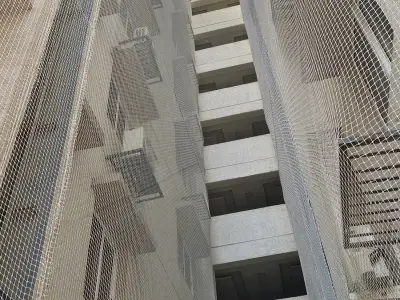
In a duct area we net across each opening or between floors, using a mesh that keeps objects and birds out but lets services stay accessible. We check where pipes, cables and AC drain lines pass so the net leaves them undisturbed.
For ducts we build removable panels or access flaps, so plumbers and electricians can still reach pipes and meters. We confirm that any maintenance access remains clear before we close off an opening.
Why safety nets for duct areas matters in Chennai
These are the problems we are called out for most often:
- Plain grills give a false sense of security when the bars are wide enough for a head or body to pass through.
- Open sections near the duct area let loose objects such as toys, pots and tools drop onto people below.
- Pets, especially cats, often jump onto the duct area edge and fall while chasing birds or insects.
- A single unprotected duct area is enough for a fall, and most incidents happen when a parent looks away briefly.
How we install safety nets for duct areas
Our team works through the following steps on a typical safety nets for duct areas job:
- We measure every edge, then cut the net to the opening with a border rope sewn along the perimeter.
- Anchor points are drilled into sound concrete or masonry and fixed with chemical or expansion anchors as the wall requires.
- Where drilling is not allowed, we use clamp-on frames or tension rods that grip the existing structure.
- The net is stretched taut between stainless-steel anchors so it does not sag when a child leans on it.
Specifications worth asking about
We normally use UV-stabilised HDPE or nylon mesh, Braided border rope, Stainless-steel anchors and hooks and Weather-resistant binding cord. Before you choose any installer, ask about the following:
- Choose a colour that blends with the building, since a well-chosen white or transparent net is barely noticeable from inside.
- Confirm that the installer tests tension at handover and explains how to check it later.
- Check that the net is UV-stabilised, because untreated nylon becomes brittle within a couple of Chennai summers.
Pricing safety nets for duct areas: the main factors
We do not quote by phone without seeing the space, because prices depend on the job. The main factors are:
- The number and type of anchor points needed depends on the wall material and the opening shape.
- Removing old nets or making good after them is charged separately if needed.
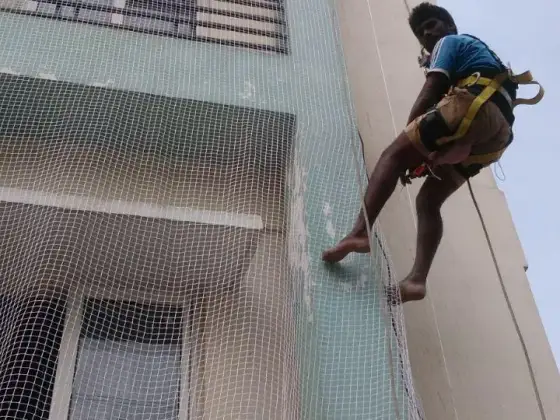
- Working at height, especially above the fifth floor, may need rope-access set-ups that add to the effort.
Our installation process
- Free site visit and measurement of the opening
- Recommendation on mesh size, colour and fixing method
- Installation by trained technicians, usually in a few hours
- Tension test, cleanup and handover with care tips
Care and maintenance
A little regular care keeps safety nets for duct areas working for years:
- Replace any section with visible cuts or fraying so the whole net stays strong.
- Rinse the net with clean water every few months to remove dust and salt.
- Check the border rope and corner anchors twice a year, especially before and after the monsoon.
Other safety nets options
If safety nets for duct areas is not quite what you need, these related options may suit your space better:
Where we install safety nets for duct areas in Chennai
We serve 50 areas across five zones of Chennai, and every area has its own page below. Along the OMR and IT corridor, including Sholinganallur, Perungudi and Navalur, tall towers face strong winds and salty air, so strength and finish matter more than usual. In North Chennai, including Perambur, Ambattur and Avadi, industrial dust, harbour salt and large pigeon flocks around railway yards and markets shape what we recommend. Across Central Chennai, including T Nagar, Anna Nagar and Mylapore, dense buildings, heritage ledges and busy roads mean every installation is cut and fixed to suit its surroundings.
Further reading: Safety net (Wikipedia)