What horizontal invisible grills involves
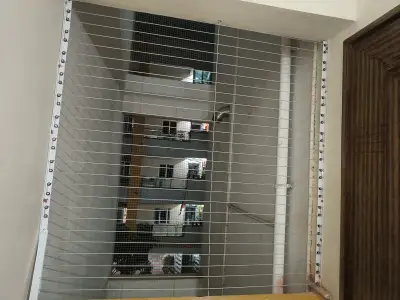
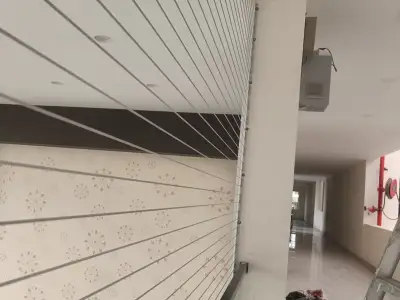
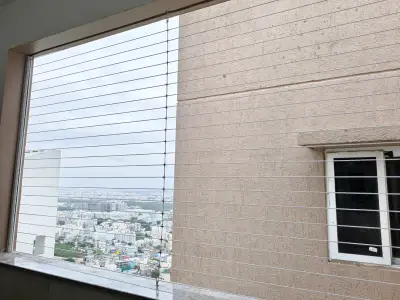
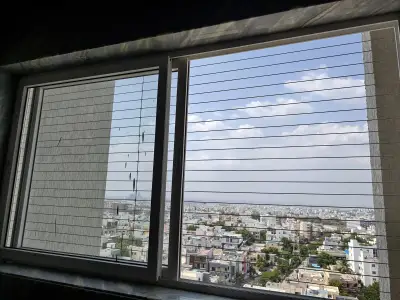
Horizontal cable runs suit openings where the priority is a clean view and moderate protection.
For horizontal layouts we fix end posts or anchors on each side and tension every cable in parallel rows. Horizontal cables can be used as a foothold, so we discuss child-safety and may recommend a different layout for toddlers.
Horizontal grills use evenly spaced cable runs, adjusted in height for the users of the space. We check spacing and end fittings carefully, since evenness is what makes horizontal grills look neat.
The case for horizontal invisible grills
The main reasons people book horizontal invisible grills are:
- Heavy metal frames on a wide opening can be difficult to fit to older walls without cracking plaster.
- Wide-spaced bars on a wide opening can let small children squeeze through or use them as a ladder.
- Uncovered openings on the wide opening make flats less appealing at resale or renting time.
- Painted mild-steel grills need repainting every year or two, and the coating peels in the monsoon.
Our horizontal invisible grills method
Our team works through the following steps on a typical horizontal invisible grills job:
- End fittings are locked and capped, so there are no sharp edges or loose ends.
- A final tension and stability test confirms that every cable is holding evenly.
- Each cable is threaded and tensioned to a firm, evenly spaced finish.
- Stainless-steel anchors or frames are fixed to the concrete, with drilling done to the manufacturer's spec.
Materials and what to look for
We normally use Stainless-steel wire rope (304 or 316 grade), Stainless-steel anchors and end fittings, Tensioning hardware and Optional powder-coated frame. Before you choose any installer, ask about the following:
- Ask which stainless-steel grade is used; 304 is common, while 316 is better near the coast.
- Look for concealed or high-quality fittings, as cheap end pieces are where corrosion usually begins.
- Ask whether the frame or anchors will be fixed into concrete or brick, and how the installer tests them.
How horizontal invisible grills is quoted
We do not quote by phone without seeing the space, because prices depend on the job. The main factors are:
- Height, access and the shape of the opening, such as corners and curves, add complexity.
- The stainless-steel grade, particularly 316 for coastal areas, changes the material cost.
- Wall type and anchoring method, concrete or brick, affect labour and fittings.
Our installation process
- Free site visit and measurement
- Design of cable pattern and spacing
- Installation, tensioning and capping
- Tension test and handover with care tips
Looking after horizontal invisible grills
A little regular care keeps horizontal invisible grills working for years:
- Check tension twice a year and re-tighten if any cable feels loose.
- Rinse away salt and dust after storms to keep the finish clear.
- Avoid hanging heavy loads on the grill or using it as a climbing support.
Other invisible grills options
If horizontal invisible grills is not quite what you need, these related options may suit your space better:
Where we install horizontal invisible grills in Chennai
We serve 50 areas across five zones of Chennai, and every area has its own page below. West Chennai, including Porur, Valasaravakkam and Poonamallee, has fast-growing gated communities where open balconies and service ducts are common and need protection. In North Chennai, including Perambur, Ambattur and Avadi, industrial dust, harbour salt and large pigeon flocks around railway yards and markets shape what we recommend. In South Chennai, including Adyar, Velachery and Besant Nagar, coastal salt, lakes and tall apartment towers call for corrosion-resistant fittings and strong anchoring.
Further reading: Stainless steel (Wikipedia)