Bird nets for buildings explained
On commercial buildings, birds cause hygiene, safety and reputation problems, particularly around entrances and food areas.
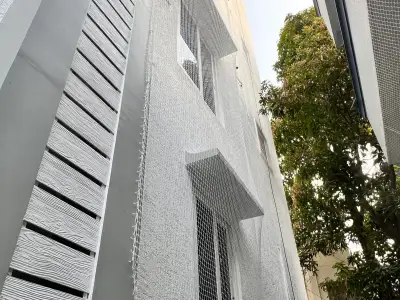
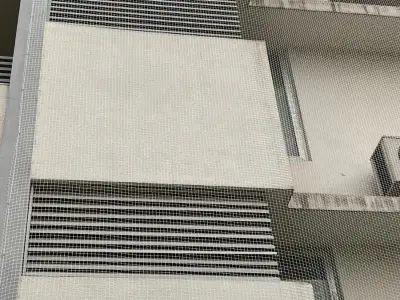
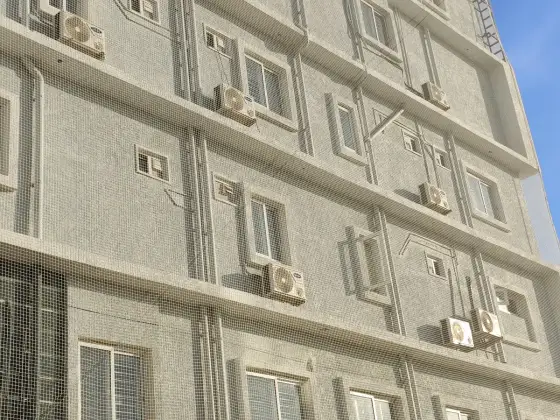
Building-scale bird netting is planned floor by floor and fixed to the structure with stainless anchors. We identify the species and the areas where they nest and feed, then plan around those.
For buildings we survey by rope access, then net ledges, voids and open spaces in sections. We coordinate work with building management so access and safety are handled cleanly.
The case for bird nets for buildings
Here is what usually leads Chennai households to ask for bird nets for buildings:
- Birds tear at cables, insulation and soft furnishings around the building ledge, causing repair costs.
- Sparrows and small birds slip through wide-mesh netting and nest inside the building ledge, so the mesh must match the bird.
- Nest material blown by wind clogs gutters, drain outlets and vents near the building ledge.
- Crows and mynas repeatedly visit an open building ledge, searching for food, nesting spots and shiny objects.
Installing bird nets for buildings step by step
Our team works through the following steps on a typical bird nets for buildings job:
- We first identify which birds are causing trouble, since that decides the mesh size.
- Seams and corners are double-secured, because determined birds work at the weakest point.
- We finish with an inspection of every seam, edge and anchor.
- The net is tensioned to prevent flapping, which reduces wear and keeps it neat.
Materials and what to look for
We normally use UV-stabilised HDPE or nylon bird net, Knotless netting for smaller mesh, Stainless-steel hooks and clips and Weatherproof binding cord. Before you choose any installer, ask about the following:
- Match the mesh to the bird: roughly 25 mm for sparrows and mynas, larger mesh for pigeons and crows.
- Ask for a net that can be opened at one point for cleaning without removing the whole panel.
- Check the installer has fitted nets on similar structures, since fixing methods differ between homes and sheds.
How bird nets for buildings is quoted
We do not quote by phone without seeing the space, because prices depend on the job. The main factors are:
- The area of netting and the total length of perimeter drive the base cost.
- Height and access method, from ladder to rope access, affect the labour involved.
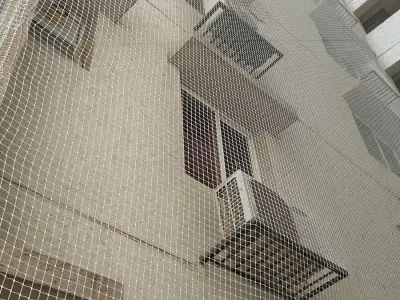
- Complex shapes and obstructions, like pipes and AC units, add time.
Our installation process
- Free site visit to identify the birds and measure the area
- Selection of mesh size and fixing plan
- Installation with every gap sealed
- Final inspection and care guidance
Looking after bird nets for buildings
A little regular care keeps bird nets for buildings working for years:
- Trim branches and creepers touching the net so they do not pull it out of shape.
- Wash the net with water every few months to remove dust and residue.
- Inspect anchors and seams after strong winds and repair small tears quickly.
Other bird nets options
If bird nets for buildings is not quite what you need, these related options may suit your space better:
Where we install bird nets for buildings in Chennai
We serve 50 areas across five zones of Chennai, and every area has its own page below. West Chennai, including Porur, Valasaravakkam and Poonamallee, has fast-growing gated communities where open balconies and service ducts are common and need protection. Across Central Chennai, including T Nagar, Anna Nagar and Mylapore, dense buildings, heritage ledges and busy roads mean every installation is cut and fixed to suit its surroundings. In North Chennai, including Perambur, Ambattur and Avadi, industrial dust, harbour salt and large pigeon flocks around railway yards and markets shape what we recommend.
Further reading: Birds of India (Wikipedia)