Bird nets for buildings: what Velachery homes face
Birds tear at cables, insulation and soft furnishings around the building ledge, causing repair costs. Very high apartment density means pigeons quickly relocate to the next unprotected balcony when one is netted.
Low-lying parts of the locality are close to wetlands, which bring water birds and crows to nearby rooftops. Scare devices and reflective tape lose their effect after a few days once birds get used to them at the building ledge.
Local notes for Velachery homes
Parts of Velachery are low-lying and close to the Velachery Lake and the Pallikaranai marsh, and the area has faced flooding during heavy monsoons. For residents, that means humid conditions for much of the year and plenty of water birds, crows and pigeons moving between the wetlands and the towers.
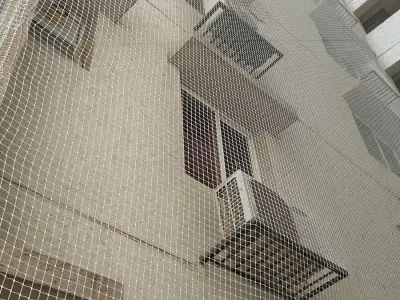
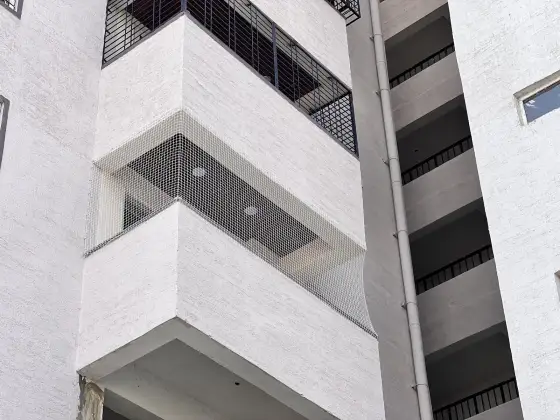
In Velachery's dense apartment blocks, pigeons quickly move to the next unprotected balcony once a neighbour nets theirs, so the problem tends to shift rather than disappear. Netting the balcony, the duct area and any AC ledges together closes off all the options at once, which is more effective than netting one opening at a time.
How we fit bird nets for buildings in Velachery
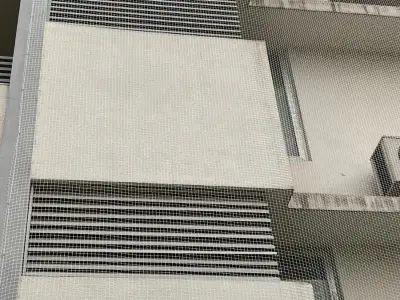
For buildings we survey by rope access, then net ledges, voids and open spaces in sections. We finish with an inspection of every seam, edge and anchor. The net is tensioned to prevent flapping, which reduces wear and keeps it neat.
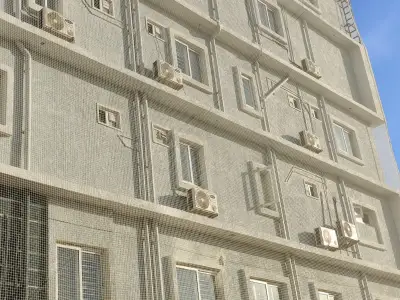
Typical properties in Velachery include high-rise gated apartments, independent houses and commercial complexes near the main road, and birds use each of them differently, so we check where they land, nest and enter before deciding the net layout.
We coordinate work with building management so access and safety are handled cleanly.
Choosing the right bird nets for buildings
For bird nets for buildings we normally supply UV-stabilised HDPE or nylon bird net, Knotless netting for smaller mesh, Stainless-steel hooks and clips and Weatherproof binding cord.
A further point for this area: Velachery's many tall apartment towers have long open balconies exposed to strong upper-floor winds.
What to ask any installer before you agree:
- Match the mesh to the bird: roughly 25 mm for sparrows and mynas, larger mesh for pigeons and crows.
- Check the installer has fitted nets on similar structures, since fixing methods differ between homes and sheds.
- Ask for a net that can be opened at one point for cleaning without removing the whole panel.
What affects the cost of bird nets for buildings in Velachery
Cost depends on what you have in Velachery, from high-rise gated apartments to independent houses. Here is what matters most:
There is no charge for the visit in Velachery, and you decide only after seeing the written quote.
- Height and access method, from ladder to rope access, affect the labour involved.
- Finer mesh for sparrows costs more than larger mesh for crows or pigeons.
- Removing an old net or clearing nests before installation may be quoted separately.
How a bird nets for buildings job works
We arrange the Velachery visit around your schedule, then confirm scope, materials and timing in writing.
- Free site visit to identify the birds and measure the area
- Selection of mesh size and fixing plan
- Installation with every gap sealed
- Final inspection and care guidance
Looking after your installation
Maintenance is light, but a few habits make a real difference in Velachery:
- Inspect anchors and seams after strong winds and repair small tears quickly.
- Trim branches and creepers touching the net so they do not pull it out of shape.
- Keep food waste and open bins away from the area to discourage repeat visits.
Serving Velachery and its neighbours
Besides Velachery, we serve Pallikaranai, Madipakkam, Guindy and Adyar and the wider South Chennai. Our team plans routes around Velachery Railway Station and Velachery Lake so visits are quick and tidy.
Further reading: Birds of India (Wikipedia)