What pigeon nets for balconies involves
An open balcony with an AC unit or clothes stand is exactly the kind of quiet corner pigeons love.
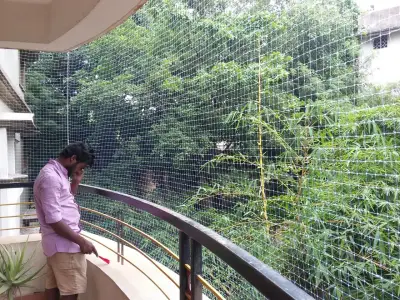
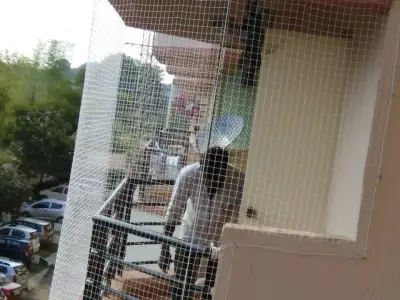
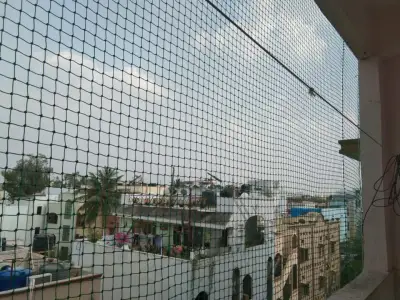
On a balcony we net from the railing up to the ceiling slab, so no gap remains above, below or at the sides. We check where the clothes line, plants and AC drain pipe sit, so the net leaves them accessible.
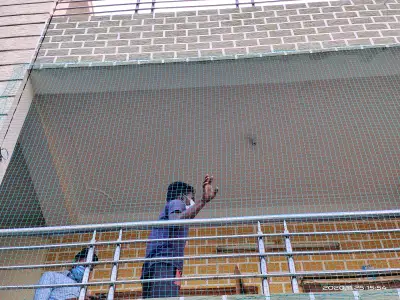
For balconies we seal the net into the walls and slab, leaving a neat, taut surface with a discreet access flap if you want one. We check the slab edge and any old pigeon nests, which need clearing before the net goes on.
The case for pigeon nets for balconies
The main reasons people book pigeon nets for balconies are:
- Spikes, gels and sprays only move pigeons for a short while, and the birds soon return to the balcony.
- Droppings on the balcony damage paint and corrode metal, and dried droppings become airborne dust.
- Bird mites and ticks from old nests can move into homes through open windows and balcony doors.
- Pigeons roost on a sheltered balcony within days of it being left open, and each pair can raise several broods a year.
Our pigeon nets for balconies method
Every job follows the same careful sequence, adapted to the building:
- Net panels are fixed to the frame with stainless-steel hooks so there are no gaps a bird can squeeze through.
- The net is tensioned so it stays taut and does not flap, which also keeps it neat and quiet in the wind.
- We measure the opening and choose a mesh small enough to keep pigeons out but still let air and light through.
- Where a nest or eggs are present, we advise on safe, humane removal before the net is fitted.
Materials and what to look for
We normally use Knotless HDPE or nylon pigeon net, UV-stabilised binding cord, Stainless-steel hooks and clips and Corrosion-resistant fixing screws. Before you choose any installer, ask about the following:
- Insist that every edge is sealed, because a partial net simply moves the birds to the gap.
- Ask for knotless nylon or HDPE netting, which is gentler on birds and stays tauter than knotted net.
- Choose mesh of about 40 to 50 mm for pigeons, since a larger mesh lets small chicks slip in.
Pricing pigeon nets for balconies: the main factors
We do not quote by phone without seeing the space, because prices depend on the job. The main factors are:
- Height and access matter, since upper-floor work may need rope-access or a suspended platform.
- The area to be covered in square feet is the main factor, with larger areas costing less per square foot.
- Awkward shapes, such as around AC units and pipes, take longer to fit and finish.
Our installation process
- Free site visit and measurement of the affected area
- Selection of the right mesh and fixing plan
- Installation sealing every gap birds could use
- Final inspection and a short care guide
Looking after pigeon nets for balconies
A little regular care keeps pigeon nets for balconies working for years:
- Hose the net gently every few months to wash off dust and any stray droppings.
- Avoid feeding pigeons nearby, because a regular feeding point draws flocks back to the area.
- Check for tears or loose hooks after storms and repair them promptly.
Other pigeon nets options
If pigeon nets for balconies is not quite what you need, these related options may suit your space better:
Where we install pigeon nets for balconies in Chennai
We serve 50 areas across five zones of Chennai, and every area has its own page below. Along the OMR and IT corridor, including Sholinganallur, Perungudi and Navalur, tall towers face strong winds and salty air, so strength and finish matter more than usual. West Chennai, including Porur, Valasaravakkam and Poonamallee, has fast-growing gated communities where open balconies and service ducts are common and need protection. Across Central Chennai, including T Nagar, Anna Nagar and Mylapore, dense buildings, heritage ledges and busy roads mean every installation is cut and fixed to suit its surroundings.
Further reading: Rock dove (Wikipedia)