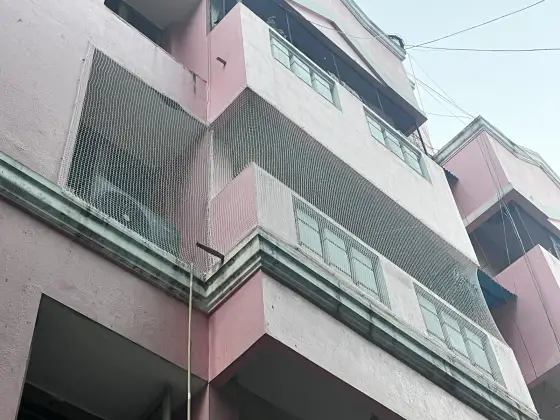
Why T Nagar properties need pigeon nets for balconies
Constant crowds and noise mean installers must work quickly and neatly, often in short access windows. Repeated cooing and flapping near the balcony disturbs sleep, especially at dawn.
Bird mites and ticks from old nests can move into homes through open windows and balcony doors. Textile and jewellery showrooms with food stalls below keep pigeons and crows crowded around the shopping streets.
What we see in T Nagar
T Nagar is Chennai's busiest shopping district, centred on Pondy Bazaar, Ranganathan Street and Usman Road, with dense residential lanes all around it. Many buildings have shops on the ground floor and homes above, and the residential streets are packed with apartment blocks standing wall to wall.
In T Nagar, pigeons feed on the shopping streets all day and roost on the flats above and behind them. Balconies, AC ledges and window sunshades facing the lanes are the worst affected. We fit nets around AC condensers and pipes and seal every gap, because in an area with this many pigeons any small opening will be found quickly.
Our pigeon nets for balconies installation approach in T Nagar
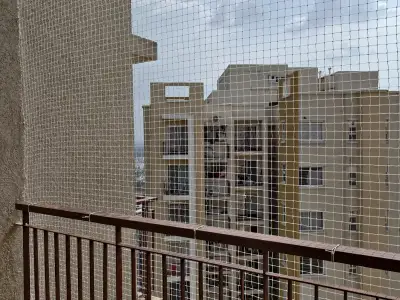
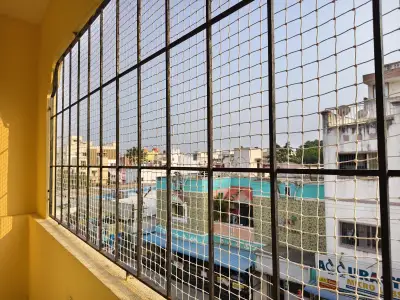
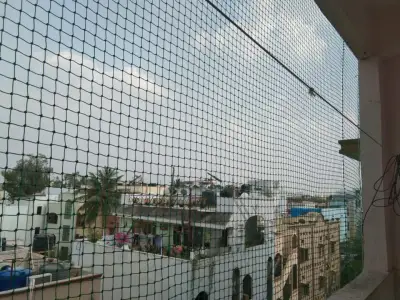
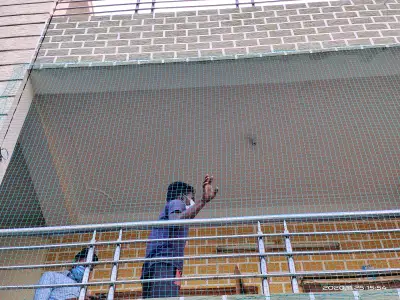
On a balcony we net from the railing up to the ceiling slab, so no gap remains above, below or at the sides. We measure the opening and choose a mesh small enough to keep pigeons out but still let air and light through. Net panels are fixed to the frame with stainless-steel hooks so there are no gaps a bird can squeeze through.
Whether it is high-density apartment blocks or old independent houses converted to flats, we walk the whole space first and note every gap a bird could use.
We check where the clothes line, plants and AC drain pipe sit, so the net leaves them accessible.
Materials we use for pigeon nets for balconies
Typical materials on a pigeon nets for balconies installation are Knotless HDPE or nylon pigeon net, UV-stabilised binding cord, Stainless-steel hooks and clips and Corrosion-resistant fixing screws.
One more local factor: Very tight building spacing means balcony nets often have to be tailored around neighbouring walls and AC condensers.
What to ask any installer before you agree:
- Look for UV-stabilised material, so the net does not turn brittle and snap in Chennai's summer sun.
- Insist that every edge is sealed, because a partial net simply moves the birds to the gap.
- Ask for knotless nylon or HDPE netting, which is gentler on birds and stays tauter than knotted net.
How pigeon nets for balconies is priced near Pondy Bazaar
We do not quote pigeon nets for balconies prices without seeing the space, because every balcony in T Nagar is different. These are the factors that move the price:
Call or message us for a free site visit in T Nagar and a written quote with no obligation.
- Height and access matter, since upper-floor work may need rope-access or a suspended platform.
- Mesh grade and cord thickness affect both price and lifespan.
- Cleaning out old nests and droppings before installation is charged separately when needed.
How a pigeon nets for balconies job works
We arrange the T Nagar visit around your schedule, then confirm scope, materials and timing in writing.
- Free site visit and measurement of the affected area
- Selection of the right mesh and fixing plan
- Installation sealing every gap birds could use
- Final inspection and a short care guide
Care and maintenance
Maintenance is light, but a few habits make a real difference in T Nagar:
- Keep plants and hanging items clear of the net so nothing tears or stretches it.
- Avoid feeding pigeons nearby, because a regular feeding point draws flocks back to the area.
- Hose the net gently every few months to wash off dust and any stray droppings.
Pigeon nets for balconies across T Nagar and nearby areas
We cover T Nagar and the neighbouring areas of Ashok Nagar, Vadapalani, Teynampet and Saidapet. Across Central Chennai, including T Nagar, Anna Nagar and Mylapore, dense buildings, heritage ledges and busy roads mean every installation is cut and fixed to suit its surroundings.
Further reading: Rock dove (Wikipedia)