What ceiling cloth hangers involves
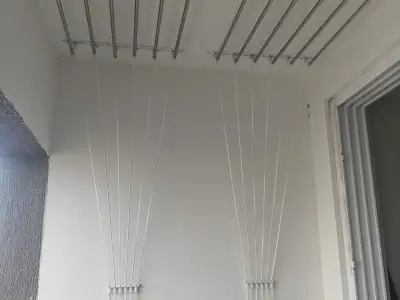
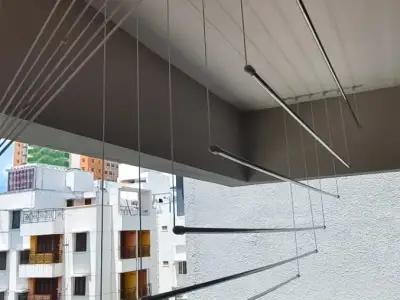
A ceiling pulley hanger is a classic answer for narrow balconies, because everything moves up and out of the way.
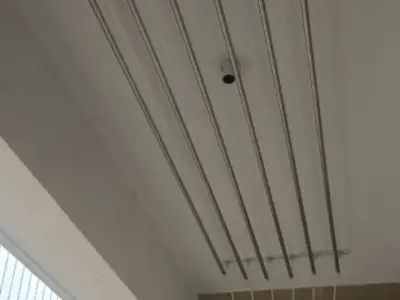
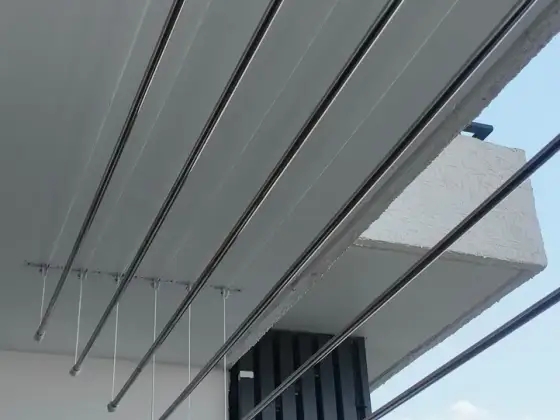
For ceiling hangers we anchor into the slab, level the frame and set the rope so every rod sits straight. We check ceiling height, fans and lights, so the raised hanger clears everything.
Ceiling hangers are fixed with expansion anchors into concrete and tested for smooth pulley action. We check the ceiling material carefully, since false ceilings need fixing into the slab above.
The case for ceiling cloth hangers
These are the problems we are called out for most often:
- A low, sagging clothes line gets in the way of doors, fans and movement.
- Cheap hangers rust or seize up quickly in humid air, which makes them stiff and unreliable.
- Damp indoor drying in a closed room raises humidity and leaves a musty smell during the monsoon.
- Poor anchoring can loosen under a heavy load of wet bedsheets or curtains.
How we install ceiling cloth hangers
This is how a ceiling cloth hangers installation normally proceeds:
- We check the ceiling or wall type first, because concrete, brick and false ceilings need different anchors.
- Mounting points are marked to be level, spaced correctly and away from fans and lights.
- Rope or cable is set to the right length so the rack sits level at every height.
- Anchors are drilled and fixed to take the full weight of a wet load with a safety margin.
Specifications worth asking about
We normally use Rust-resistant aluminium rods, Stainless-steel pulley and fittings, Nylon rope or cable and Expansion anchors and screws. Before you choose any installer, ask about the following:
- Make sure the fixing type suits your ceiling, especially if you have a false ceiling.
- Confirm that the mechanism runs smoothly by pulling it up and down before you accept the job.
- Check the weight rating, and choose a bigger capacity if you dry bedsheets and curtains.
What affects the price of ceiling cloth hangers
We do not quote by phone without seeing the space, because prices depend on the job. The main factors are:
- Removal of an old hanger is quoted separately when required.
- Additional features, such as extra rods, covers or a longer rope, add to the price.
- The model, number of rods and load rating are the biggest cost factors.
Our installation process
- Free assessment of your balcony or utility area
- Recommendation of the right hanger and fixing
- Installation and smooth-run testing
- Weight test and demonstration
Care and maintenance
A little regular care keeps ceiling cloth hangers working for years:
- Wipe the rods and pulley with a dry cloth every month to avoid rust and dust.
- Check the ceiling anchors and rope once or twice a year and replace worn parts.
- Do not exceed the rated weight, and spread wet laundry evenly across the rods.
Other cloth hangers options
If ceiling cloth hangers is not quite what you need, these related options may suit your space better:
Where we install ceiling cloth hangers in Chennai
We serve 50 areas across five zones of Chennai, and every area has its own page below. In South Chennai, including Adyar, Velachery and Besant Nagar, coastal salt, lakes and tall apartment towers call for corrosion-resistant fittings and strong anchoring. Along the OMR and IT corridor, including Sholinganallur, Perungudi and Navalur, tall towers face strong winds and salty air, so strength and finish matter more than usual. Across Central Chennai, including T Nagar, Anna Nagar and Mylapore, dense buildings, heritage ledges and busy roads mean every installation is cut and fixed to suit its surroundings.
Further reading: Clothes line (Wikipedia)