The local case for bird nets for buildings in Valasaravakkam
The wide main road brings steady dust, so exposed steel cables and grills should be cleaned after installation. Crows and mynas repeatedly visit an open building ledge, searching for food, nesting spots and shiny objects.
Droppings and food scraps on the building ledge attract flies and ants, creating hygiene problems. Many homes here are duplexes with open first-floor balconies that pigeons find easy to enter.
Bird nets for buildings in Valasaravakkam: local guide
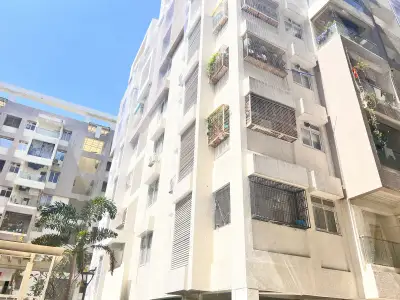
Our office is on Velan Nagar Main Road in Valasaravakkam, so this is the locality we know best, street by street. Valasaravakkam runs along Arcot Road between Virugambakkam and Porur, and most of its residential nagars began as independent houses on individual plots. Over the years many of those plots have been rebuilt as stilt-plus-four apartment blocks, so one street can have a single-storey house from the 1980s next to a brand-new five-level building.
In Valasaravakkam, pigeons tend to settle in the narrow gaps between closely built apartment blocks, on AC outdoor units and under the sunshades of older houses, where they are sheltered from both sun and rain. Because buildings stand so close together, one open duct or sunshade can become a nesting spot that affects several flats, so we often suggest covering the shared gap rather than a single balcony.
Fitting bird nets for buildings to Valasaravakkam buildings
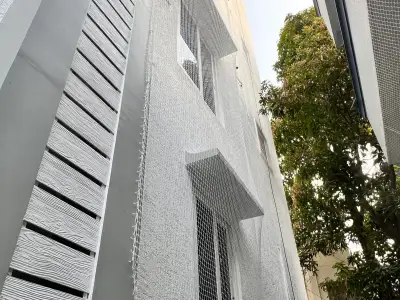
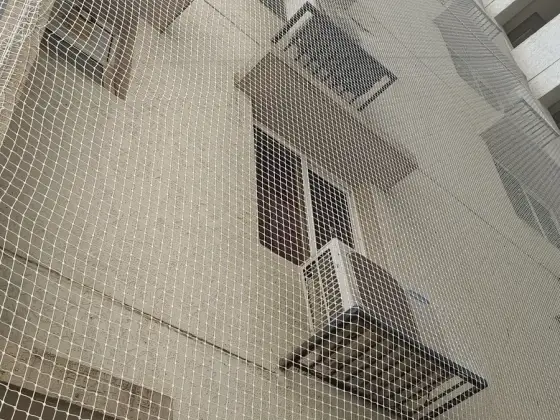
Building-scale bird netting is planned floor by floor and fixed to the structure with stainless anchors. Access flaps or zips are added where cleaning or servicing is needed. Net panels are cut to fit the space, then fixed with stainless hooks so there are no gaps to squeeze through.
Because Valasaravakkam has independent houses and duplexes alongside mid-size apartment buildings, we survey each property separately instead of using one standard net size.
We identify the species and the areas where they nest and feed, then plan around those.
Materials and specifications
You can expect UV-stabilised HDPE or nylon bird net, Knotless netting for smaller mesh, Stainless-steel hooks and clips and Weatherproof binding cord on a bird nets for buildings job with us.
Worth knowing: Nearby IT campuses at Ramapuram keep apartment demand and construction activity high.
What to ask any installer before you agree:
- Choose UV-stabilised HDPE or nylon so the net stays flexible and strong outdoors.
- Match the mesh to the bird: roughly 25 mm for sparrows and mynas, larger mesh for pigeons and crows.
- Ask for a net that can be opened at one point for cleaning without removing the whole panel.
How bird nets for buildings is priced near Arcot Road
A fair quote for bird nets for buildings near Alwarthirunagar comes from measuring the actual space. These points decide the number:
There is no charge for the visit in Valasaravakkam, and you decide only after seeing the written quote.
- Complex shapes and obstructions, like pipes and AC units, add time.
- Finer mesh for sparrows costs more than larger mesh for crows or pigeons.
- The area of netting and the total length of perimeter drive the base cost.
How a bird nets for buildings job works
After the first visit near Arcot Road, you receive a written scope so there are no surprises on the day of installation.
- Free site visit to identify the birds and measure the area
- Selection of mesh size and fixing plan
- Installation with every gap sealed
- Final inspection and care guidance
Care and maintenance
Maintenance is light, but a few habits make a real difference in Valasaravakkam:
- Wash the net with water every few months to remove dust and residue.
- Inspect anchors and seams after strong winds and repair small tears quickly.
- Trim branches and creepers touching the net so they do not pull it out of shape.
Areas we cover around Valasaravakkam
We cover Valasaravakkam and the neighbouring areas of Virugambakkam, Porur, Vadapalani and Iyyappanthangal. West Chennai, including Porur, Valasaravakkam and Poonamallee, has fast-growing gated communities where open balconies and service ducts are common and need protection.
Further reading: Birds of India (Wikipedia)